
David Chmelík Looks Back and Ahead
David Chmelík and his courage to start over
Slawenburg’s bankruptcy is well known, but the name David Chmelík is synonymous with disaster in this tourist-oriented region, a region with centuries-old Slavic traditions. David Chmelík is aware of his responsibility—and he faces it head-on. That, for starters, is a big plus for him. Earlier this week, he spoke at the Radduscher Sports and Culture Barn about his reasons for taking over the castle, his failure, and his plans for the future. About two dozen visitors had come—creditors, interested parties, and curious onlookers alike—and residents of Raddusch were also present, because with the loss of the castle, the town has also lost some of its appeal.
“My companion and I would have loved to stop for a coffee at the castle during our bike tour, but a 13-euro admission fee for that is outrageous,” interjected Daniela Werban, a resident of Raddusch, pointing out a problem that has existed ever since the castle was built. “The locals have known about the exhibition for a long time, but they just wanted to stop by,” she adds in response to Chmelik’s remark that too few locals were visiting the castle.
David Chmelík explained in detail why the castle went bankrupt, backing up his explanation with facts and figures. He also spoke about his naivety in believing that he could “somehow manage” the enormous operating and labor costs, because a place like Slawenburg magically attracts visitors and generates enough admission fees to cover its costs—or so he was convinced at the time. David Chmelik: “It was the first bankruptcy of my life, but it must not be the end of my story—the story of my life dedicated to the Slavic people! It was my mistake to lose sight of the total costs; I focused too much on profitable events—but attendance was just so-so, especially in the winter. Eventually, I became insolvent.”
David Chmelík promised to personally cover the outstanding debts that some people are still demanding he pay. Dr. Haschke, a wastewater treatment plant engineer from Preilack, called for this, as did Sylvia Domke from Briesen regarding transportation services. “I need the money—after all, it’s 1,070 EUR for two months of shuttle service to the castle,” she told her former client. The wastewater treatment plant contractor still had two of three invoices from May 2025 outstanding; they total 550 EUR. In front of an audience, Chmelik stated on several occasions that he would enter into legally binding agreements—possibly including installment payment plans—in order to satisfy all of his creditors.
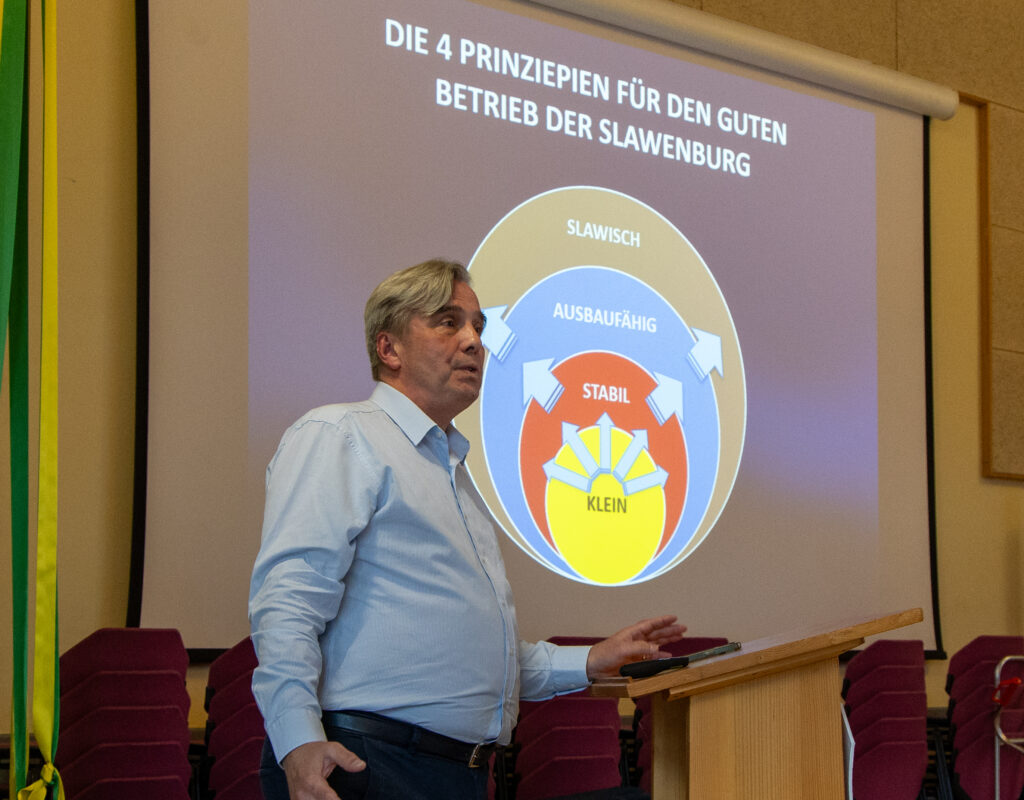
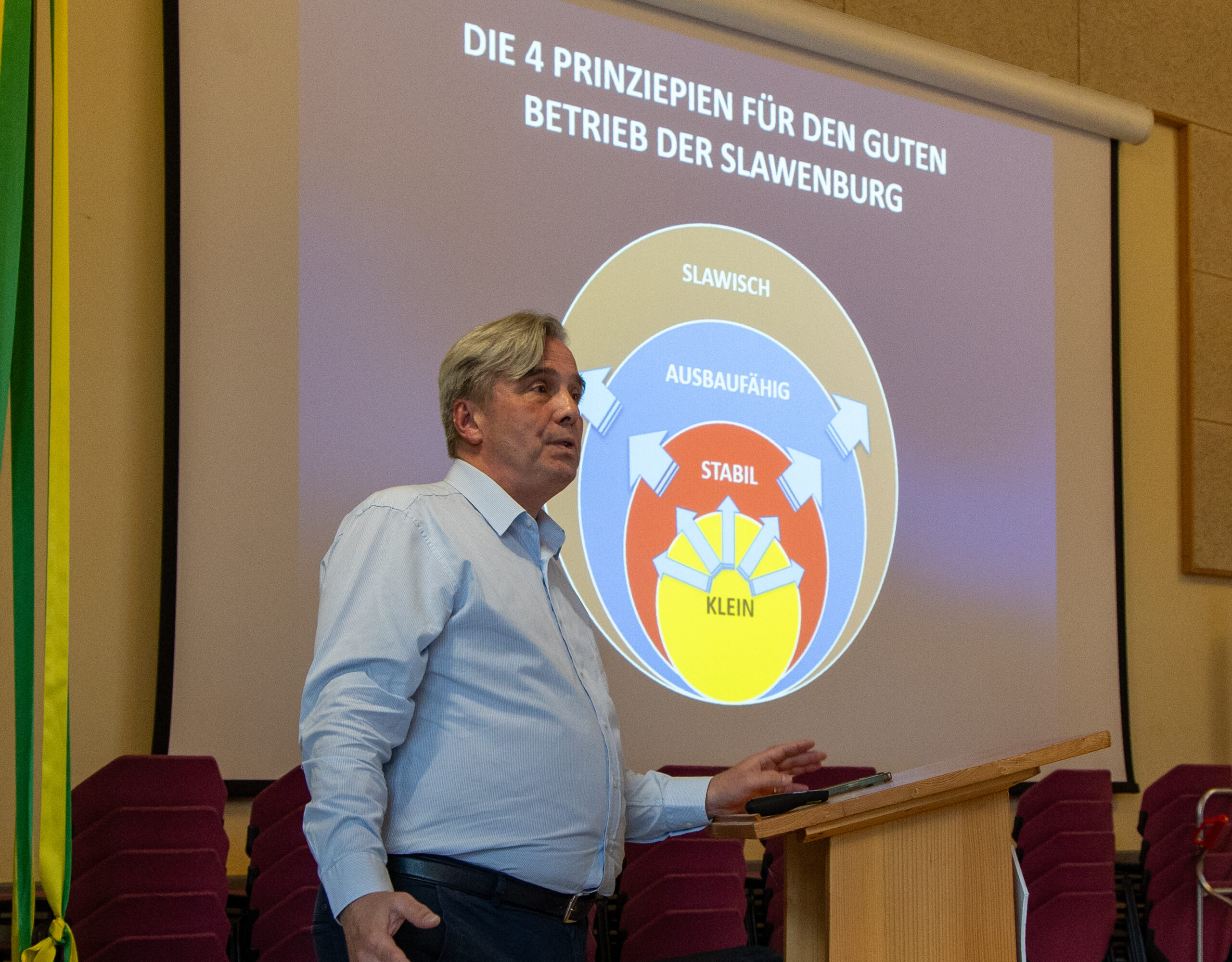
He had some advice on how to run a castle under new circumstances: The castle must be small, sturdy, expandable, and, above all, always Slavic. “I haven’t given up on the castle yet!” For bike shower advocate Björn Birkhold-Jordan, this was an opportunity to ask his question: “How do you plan to win over the city council members again after all this disaster?” David Chmelík expressed his conviction that his new concept, backed by solid guarantees, would be persuasive enough.
David Chmelík also used the evening to present his latest project, which promises relatively low costs but potential profits. “I am Slav at heart, and I want to do everything I can to bring Slavic culture—especially that of the two Lusatias—into the hearts of others as well. We Lusatians are the bridge between Western and Eastern Europe, and I am firmly convinced that this can, should, and will be reflected in increased visitor numbers.”
The “Slavic World of Lusatia” project is supported by the Slavonic Europe Foundation, based in Brussels, which serves as a network for global Slavic cooperation. At its core is an online platform that showcases cross-border activities in the Slavic region. It is intended to serve as a digital calendar of events, and products bearing a “Slavic” label will also be marketed there. (slowjanskiswet.eu)
After an hour and a half of what was more or less a monologue, the event came to an end. Some visitors left the room shaking their heads, some looking pensive, and some left before the event was over. David Chmelík was nevertheless satisfied, as he finally had the opportunity to settle the score and, at the same time, present his new project. “Coincidentally, July 6—the day of our event—is a Czech national holiday: Jan Hus was burned at the stake on this day in 1415 because he stood by his beliefs and refused to recant them.” That was left hanging in the air for the time being.
Peter Becker, July 13, 26

