
Rare orchids in the Spreewald
Nature conservation and a love of nature don’t end when you reach retirement age
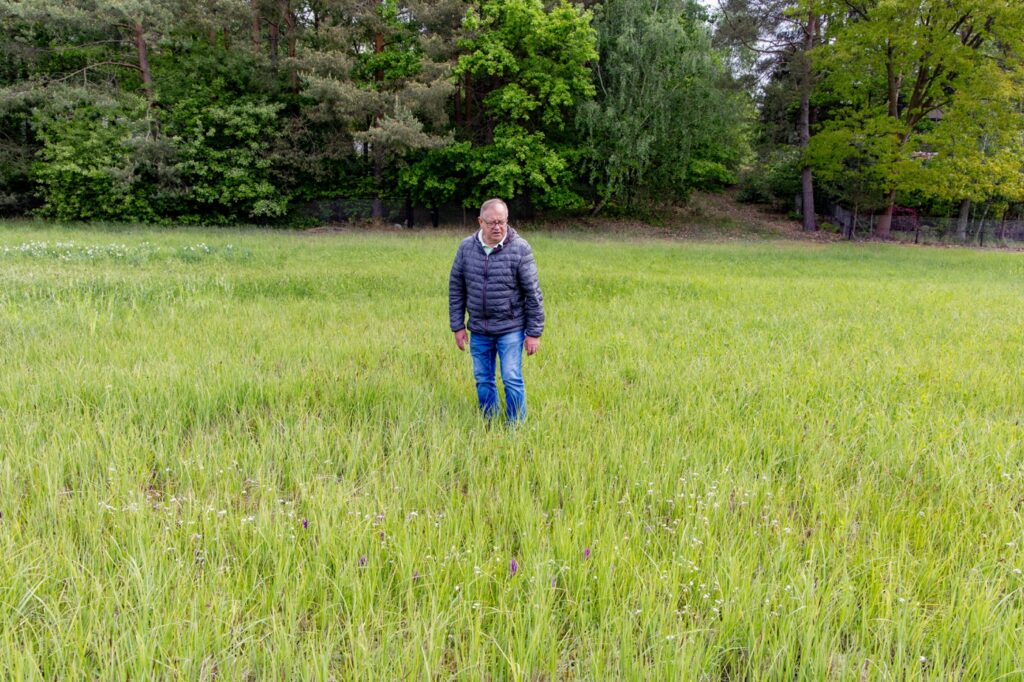
Hans Jurk is still often out and about in his former workplace, the Spreewald. The nature warden, who retired from the biosphere reserve in 2015, looks into the most remote corners, remembering that he once recorded plant populations for years as part of a monitoring program, especially the strictly protected ones.
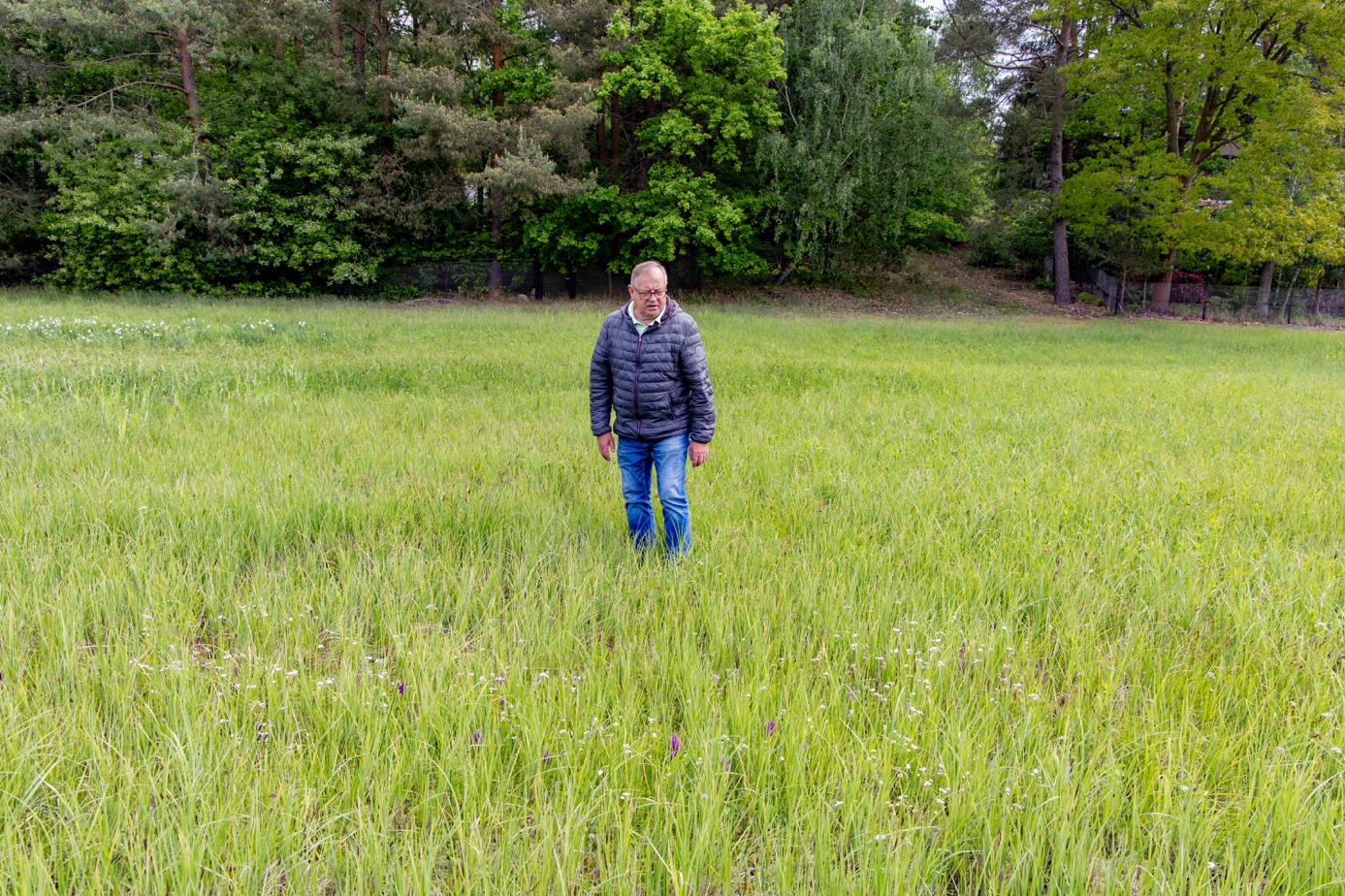
Hans Jurk during a stock inspection: He only walks on the edge of the area covered with orchids (purple “dots” in the wet meadow) to avoid disturbance.
He is particularly fond of the orchid, as this striking purple-flowered plant is visible from afar. Hans Jurk: “That’s why I was upset just yesterday that an angler had probably driven his car through the clearly visible stands of plants in search of the shortest route. We are so glad that these Spreewald plants, which are orchids, are recovering thanks to strict protection – and then something like this!” Jurk blames the perpetrator for perhaps not even knowing what he was doing.
The orchid is picky, it needs unfertilized, moist to wet meadows, which are typical for the Spreewald. As these soils must be low in nutrients, the orchid reacts sensitively to over-fertilization or mowing too early. The seeds of the orchid are tiny and have no nutritive tissue of their own. In order for the seed to germinate at all, it is dependent on the help of a certain root fungus (mycorrhiza), which supplies it with nutrients. The plant is therefore also very sensitive to shocks, which can destroy the root network.
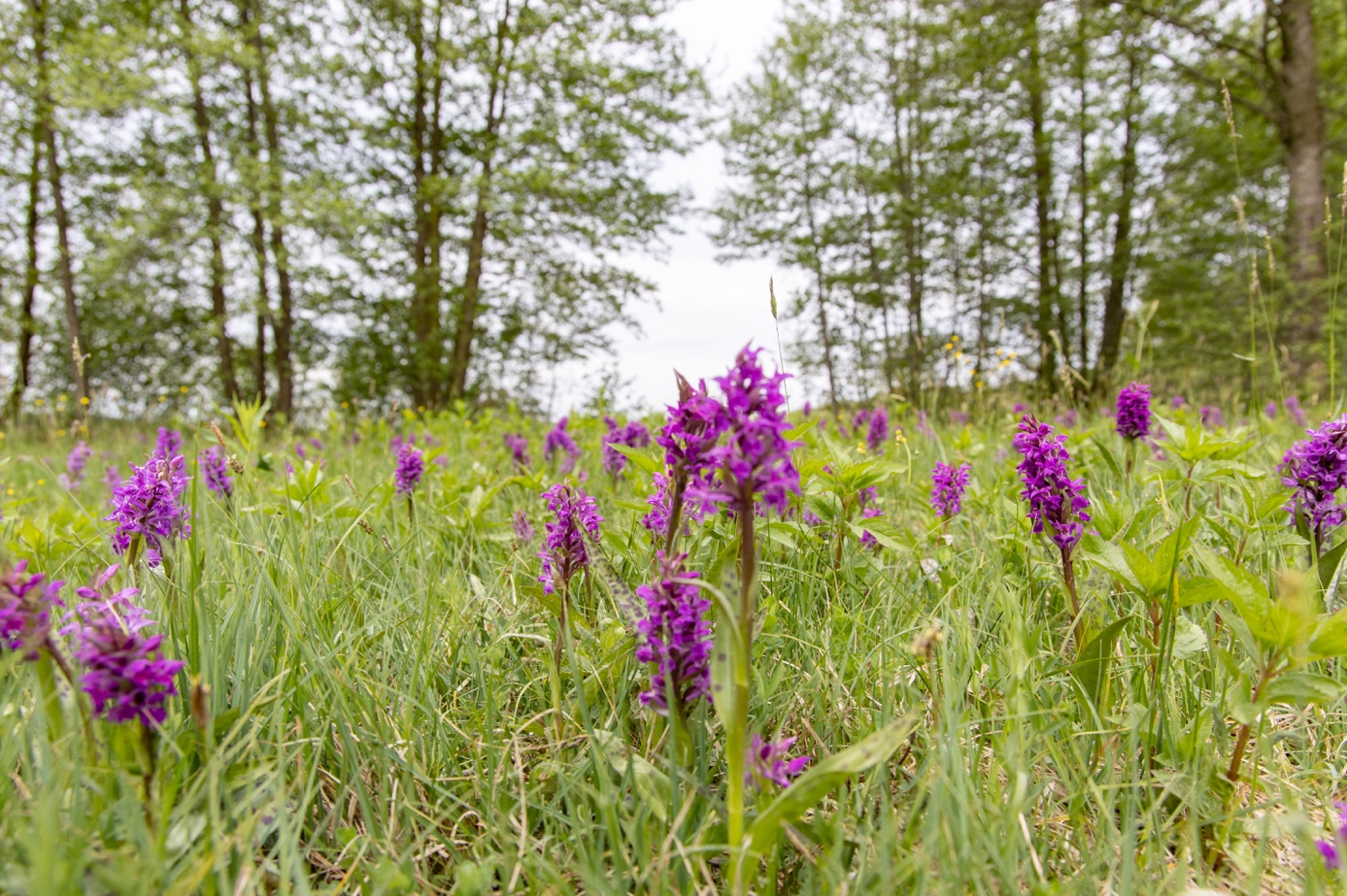
Several orchids (spotted orchid) can be found in just one wet meadow.
The plant gets its name from the two differently sized and testicle-shaped root tubers. In folk medicine, eating the larger tuber was therefore considered to guarantee the conception of a boy.
Botanists distinguish between the broad-leaved orchid, which is also known as the spotted orchid because of the clearly visible spots on its leaves, and the unspotted orchid, which is even rarer in the Spreewald.
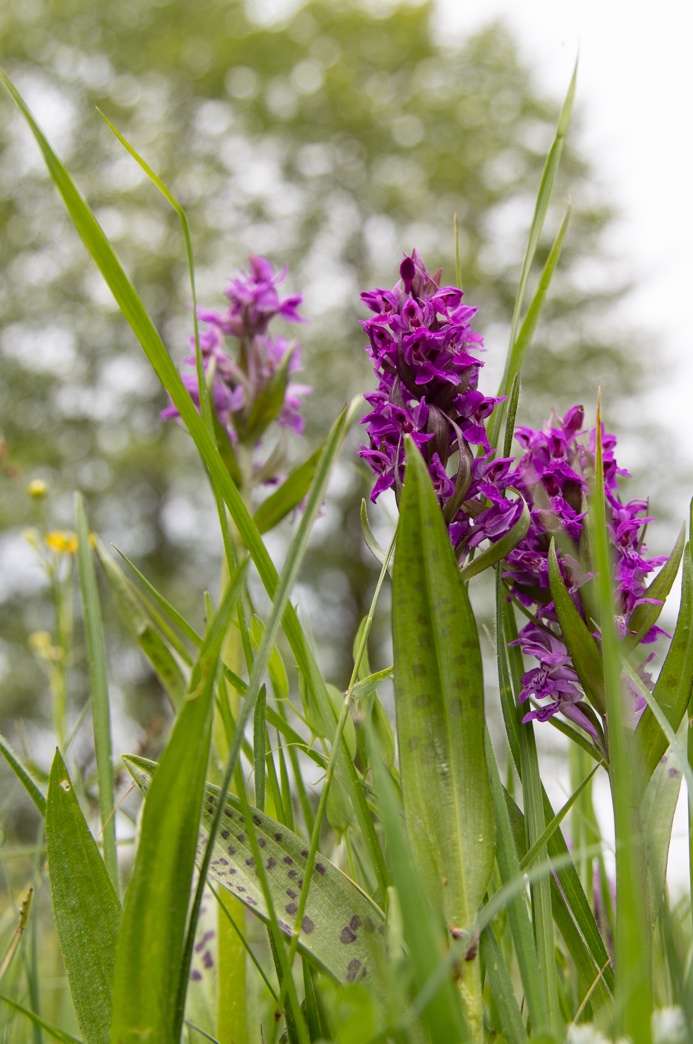
The “Spreewald orchid” is also known as the spotted or broad-leaved orchid and only blooms for a short time.
Hans Jurk is always on the lookout for surprises on his tours; he hopes and even looks for them as a sign of a reviving nature, of ecological diversity. He already has one success to his name: The two-leaf. This orchid, which is also strictly protected, occurs in very few locations in the company of the orchid. “So far I’ve only discovered it in one place, it’s very inconspicuous, you can only see the flowers if you look closely,” says Jurk as he scans the wet meadow. The search is not successful for long, after all, he had already discovered her days ago.
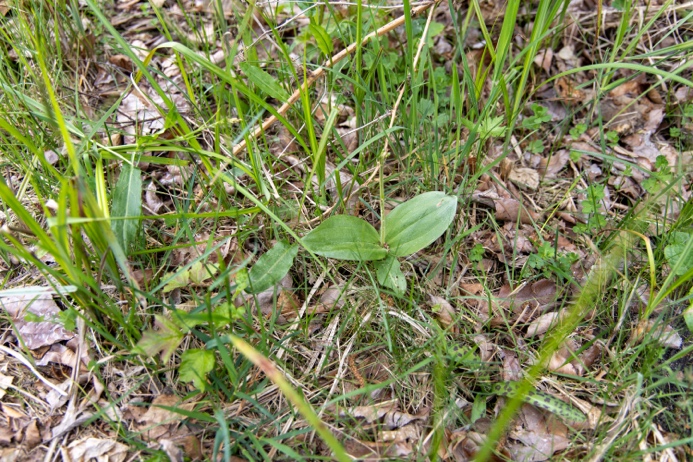
The large bifolium with its inconspicuous flower stalk. At the bottom right, a spotted orchid emerges from the ground.
Just like the orchid, the greater orchid is strictly protected under the Federal Nature Conservation Act. It may neither be picked nor dug up.
Hans Jurk is pleased with the slight recovery of the rare orchid species. “At the time, we managed to agree with the owners of the area that it would only be mowed well after the flowering period. Fertilization must also be avoided,” says the conservationist, who will always be a conservationist at heart. “I enjoy the natural meadows and fallow land, because only here can nature recover and produce biodiversity. Others may see it differently, for them they are unkempt, overgrown areas – but that’s exactly what we need!” adds Hans Jurk. He will continue his rounds over the next few days to see what surprises nature has in store.
Michael Petschick from the Spreewald biosphere reserve administration on the occurrence of strictly protected plants:
The UNESCO Spreewald Biosphere Reserve is a model region for the adapted and sustainable use of the cultural landscape, providing a new habitat for many animals and plants that have become rare in Germany. Species such as marsh ragwort, riparian wolf’s bane, marsh forget-me-not and bog ragwort, and habitat types such as moor-grass meadows, wet tall herb meadows, burnt umbel meadows and lean lowland meadows remind us how important the water balance of the Spreewald region is for our animals and plants. In the past, human intervention in nature was aimed at efficiency and performance. This resulted in drainage and over-fertilization and thus the destruction of many habitats. Today, extensification and cultivation adapted to the soil and water conditions have restored the diversity of our native nature. With over 120 contracts for the adapted use of the Spreewald meadows on approx. 2300 hectares – that’s about 3220 standard soccer pitches – the UNESCO biosphere reserve supports the joint efforts of the Spreewald people to reconcile the protection, care and development of our cultural landscape for the benefit of people and nature.
Peter Becker, 20.05.26

