
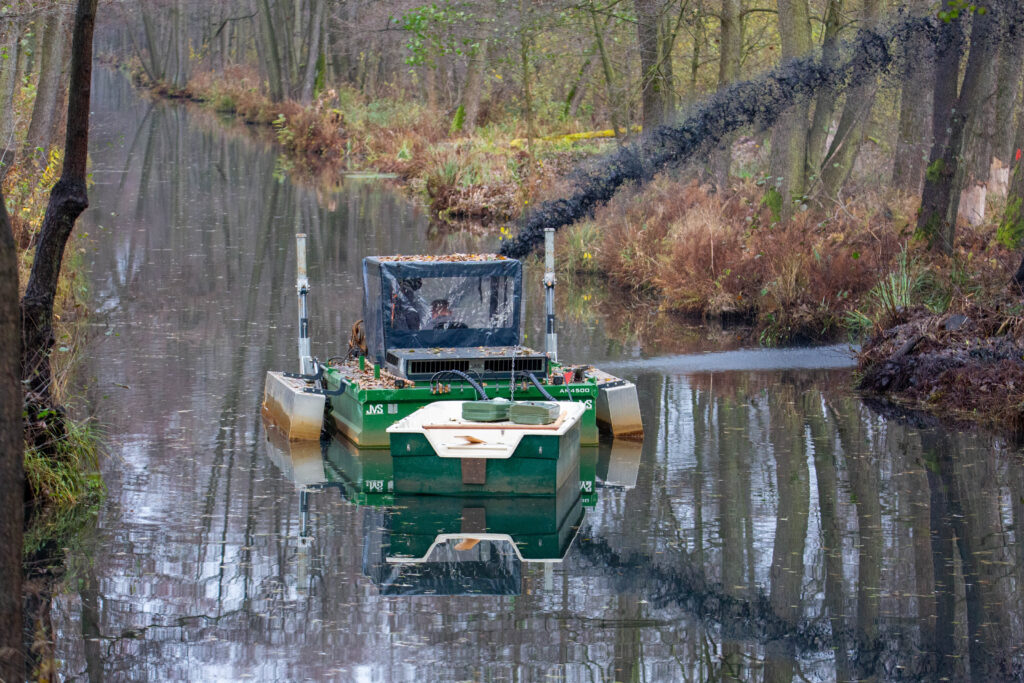
Desilting work in the Spreewald
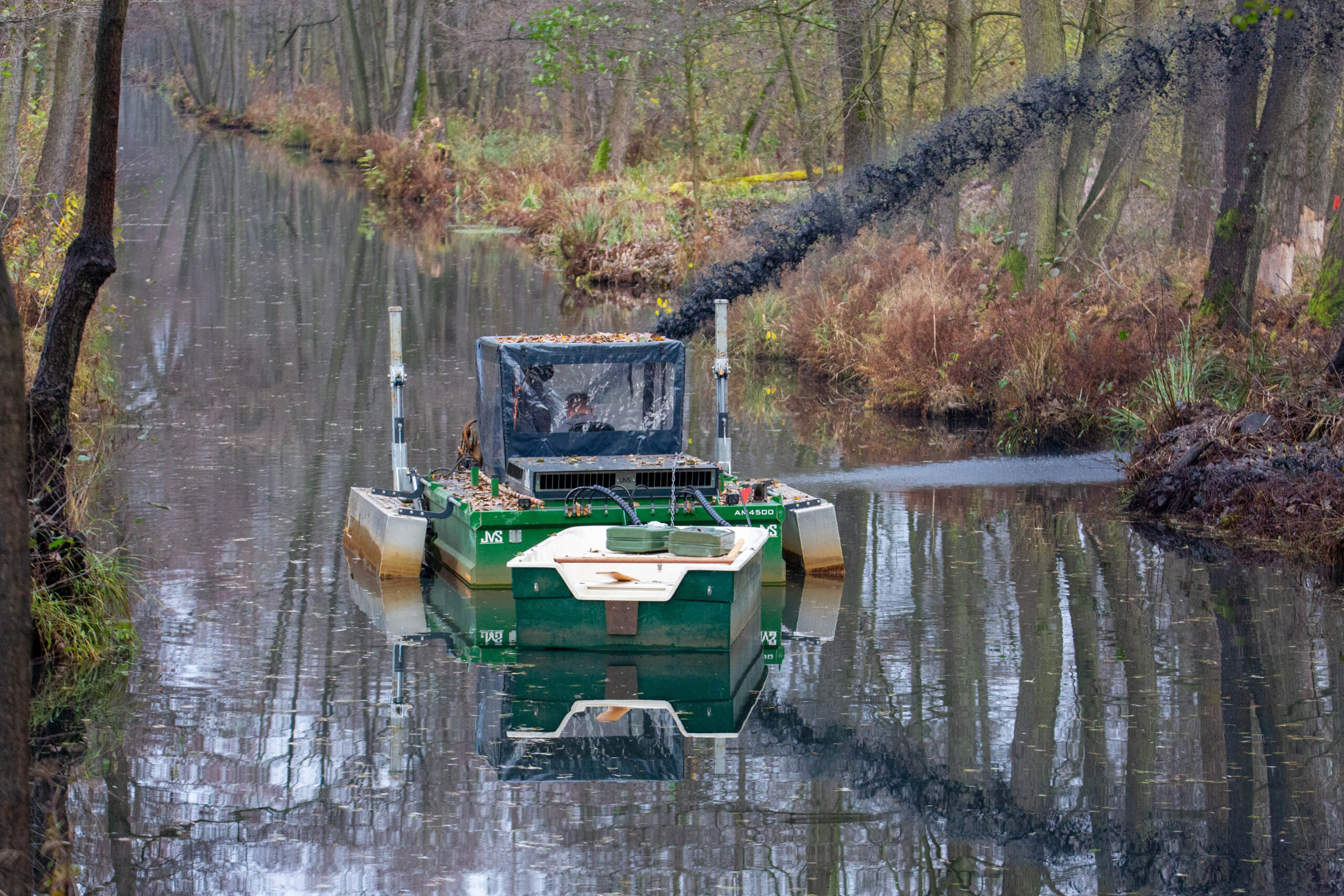
The almost annual floods in the Spreewald were once greatly feared, as they all too often destroyed livelihoods and cost the lives of animals and people. One aspect of the floods fades into the background in this context: the “flushing” of the Spreewald rivers! The silt deposits caused by leaves and herbs along the banks were generally short-lived, as the strong current of the increasing water masses carried the silt over the banks. As a result, the fields and meadows were supplied with nutrients in a natural way – despite all the damage. The artificially created annual winter dams achieve a similar effect through the flooding water, but the deposits in the rivers are not significantly eliminated. The creation of the dam belts in the Spreewald and the Bautzen (commissioned in 1977) and Spremberg (commissioned in 1965) dams in the Spree tributary virtually eliminated the risk of flooding.
Two methods are used by the State Office for the Environment to remove the sludge: Narrowing the watercourse using fascines and pumping out the sludge using a suction spraying process. The first method serves to increase the flow velocity with the effect of flushing out the decomposition products and at the same time preventing the deposition of leaves. In 2025, such measures were carried out on the Scheidungsfließ and in the Große Wildbahn in Burg. The “Oberland Calau” water and soil association implemented this for the first time a few years ago at Dorotheengraben in Lübbenau. The contractor, Wasser- und Bodenverband “Oberland Calau”, uses a suction flushing boat for the suction spraying process.
Thomas Frey from the State Office for the Environment: “The prerequisite is that the sprayed sludge has similar properties to the bog soil on which it is sprayed. For this purpose, extensive analyses of the water sludge and the soil are carried out in advance and compared with each other. This ensures that there is no incompatible contamination of the soil.” However, this was not always the case: the sludge often contained harmful deposits that would only have been transported from the bottom of the water to the banks by the suction spraying process. At times, the sludge even had to be treated as hazardous waste.
Thomas Frey: “The composition of the sludge has changed with the decline of lignite mining and the stricter regulations for industrial wastewater. Whereas in GDR times the sludge was still heavily contaminated with pollutants due to heavy inflows from the coal region, today it is mainly formed en masse from the leaves of the trees along the banks. Due to the declining flow rates and the associated low flow velocities in the Upper Spreewald, the leaves are deposited in large quantities on the river bed and have led to increased sludge formation in recent years.”
In addition to the “First Freedom Canal”(photo), the Upper Spreewald was desilted this year using the suction-spraying method: Ogrena, Uska Luke, Sapolla, Moorige Tschummi, Rollkanal, Bürgergraben, Dlugybuschfließ. Next year, the work will continue in other flows.
In order to preserve the Spreewald rivers as a habitat for the species-rich fish and insect world, activities to desilt the rivers have been intensified again since 2025, as there is a risk of asphyxiation due to oxygen depletion with large amounts of sludge.
Peter Becker, 12.12.25

